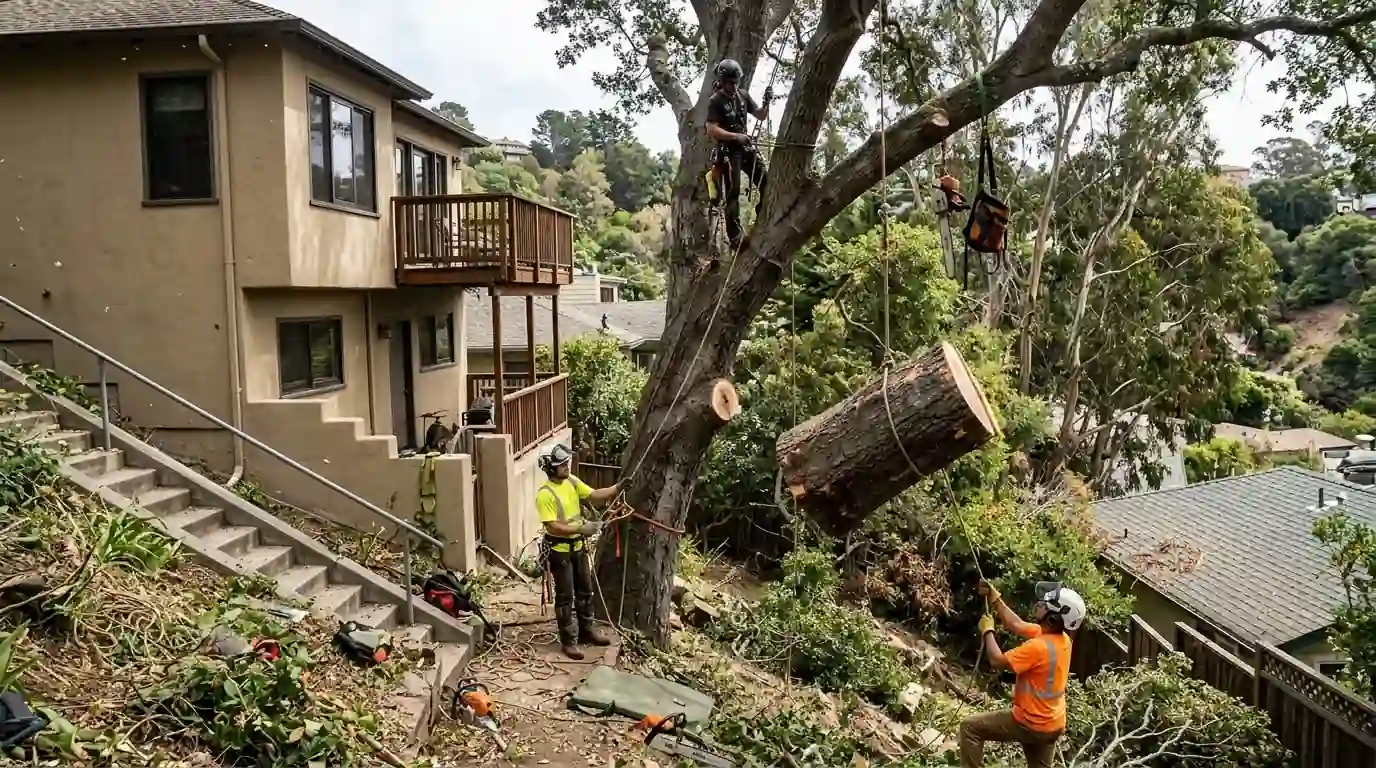
Crane-assisted tree removal in Oakland, CA
When a big tree towers over a house with nowhere to lower wood, a crane lifts it out in large pieces. We plan the street setup, the picks and the landing zone for Oakland's tight lots.
Quick answer
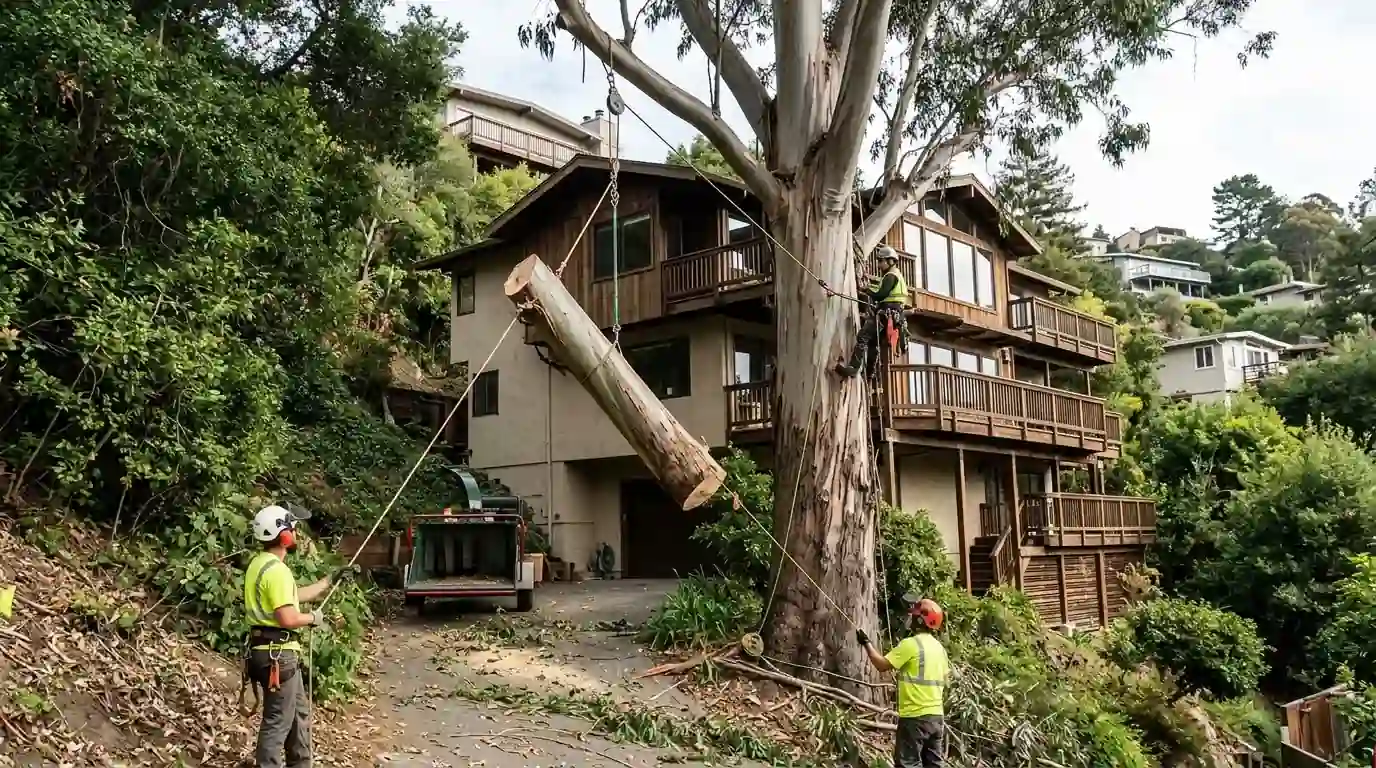
Crane-assisted tree removal uses a truck crane to hold and lift trunk sections while our climber cuts them free. It's the right method when a tree is too big, too weak or too boxed in to lower by rope, such as a tall eucalyptus over a roof. We plan the crane spot, any street permits, the picks and the landing area before the work day.
What crane-assisted tree removal involves in Oakland
Climbing and rope lowering handle most trees. A crane earns its place when the tree is huge, the wood is unsafe to climb, or there's no open ground to lower pieces into. A 100-foot blue gum standing between two houses on a hillside lot is the classic case. Instead of cutting dozens of small pieces, our climber rigs a large section to the crane hook, cuts it, and the operator lifts it clear over the roof.
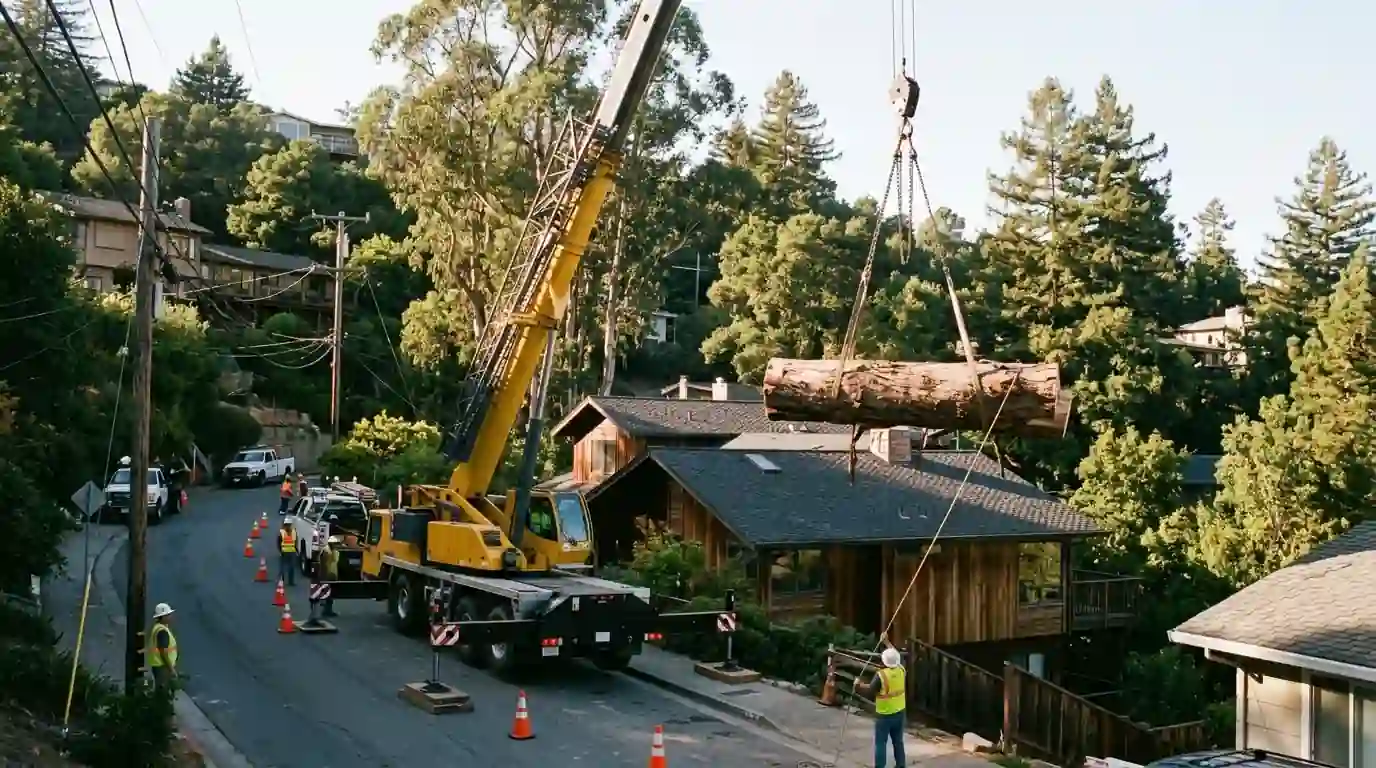
Picks get planned around weight, not guesswork. Green eucalyptus and pine wood are heavy, and a crane's capacity drops quickly as the boom reaches farther out. We estimate the weight of each section, then size the pieces to what the crane can safely carry at that distance. That's why a crane on the street right in front of a house can take much bigger pieces than the same crane reaching across a backyard.
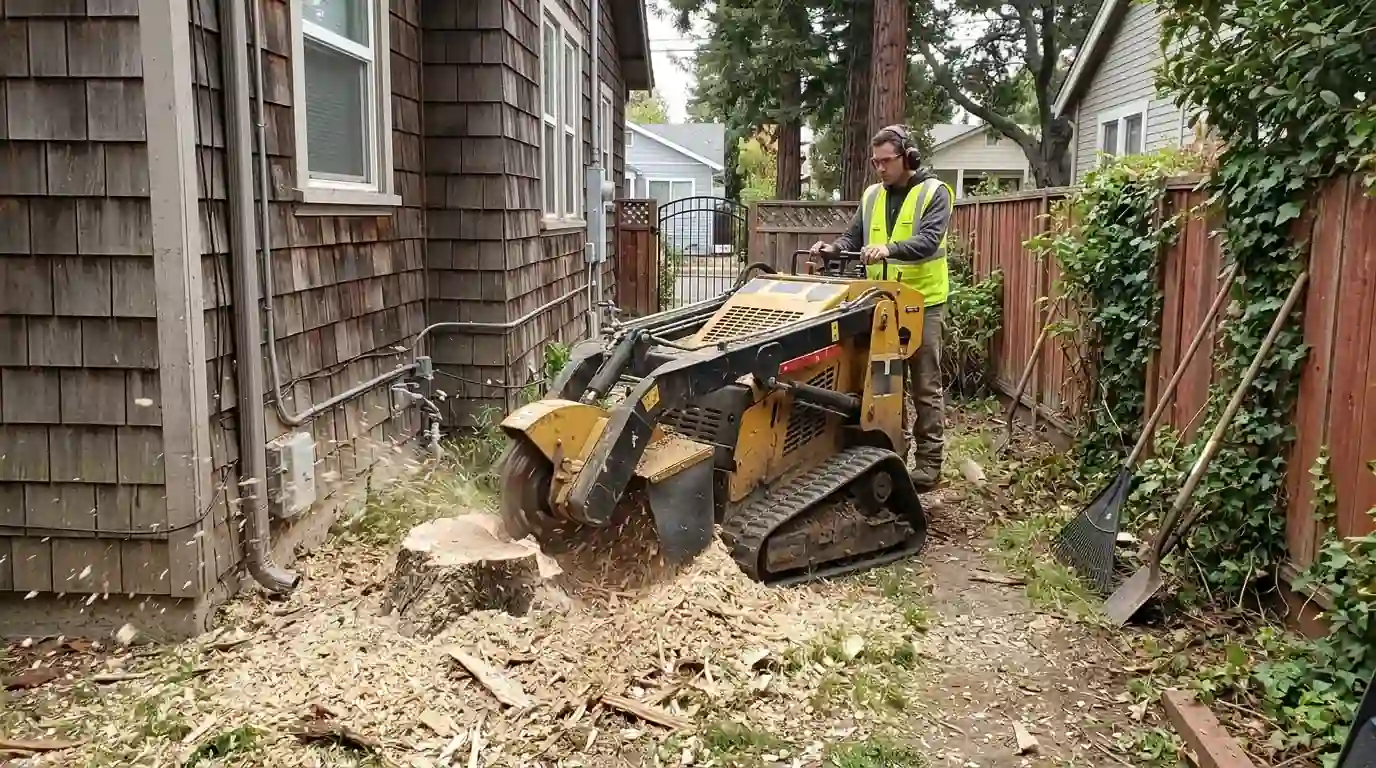
A crane often makes a job shorter and gentler on the property. Fewer pieces means fewer cuts and less time with a climber high in a risky tree. Nothing gets dragged across lawn or garden beds, and the wood lands right beside the chipper and log truck. On a hazardous tree that can't be climbed, the crane holds the top while it's cut, so weak wood never has to carry a rope load. Once the trunk is gone, we can grind the stump the same day.
Which Oakland trees usually call for a crane?
- Very tall eucalyptus near the houseBlue gums grow huge and heavy, and their wood sheds bark and limbs, which makes long climbs slower and riskier.
- Trees that overhang a roof all the way aroundWith no open landing spot, every piece would have to be lowered by hand, so lifting them out is often cleaner.
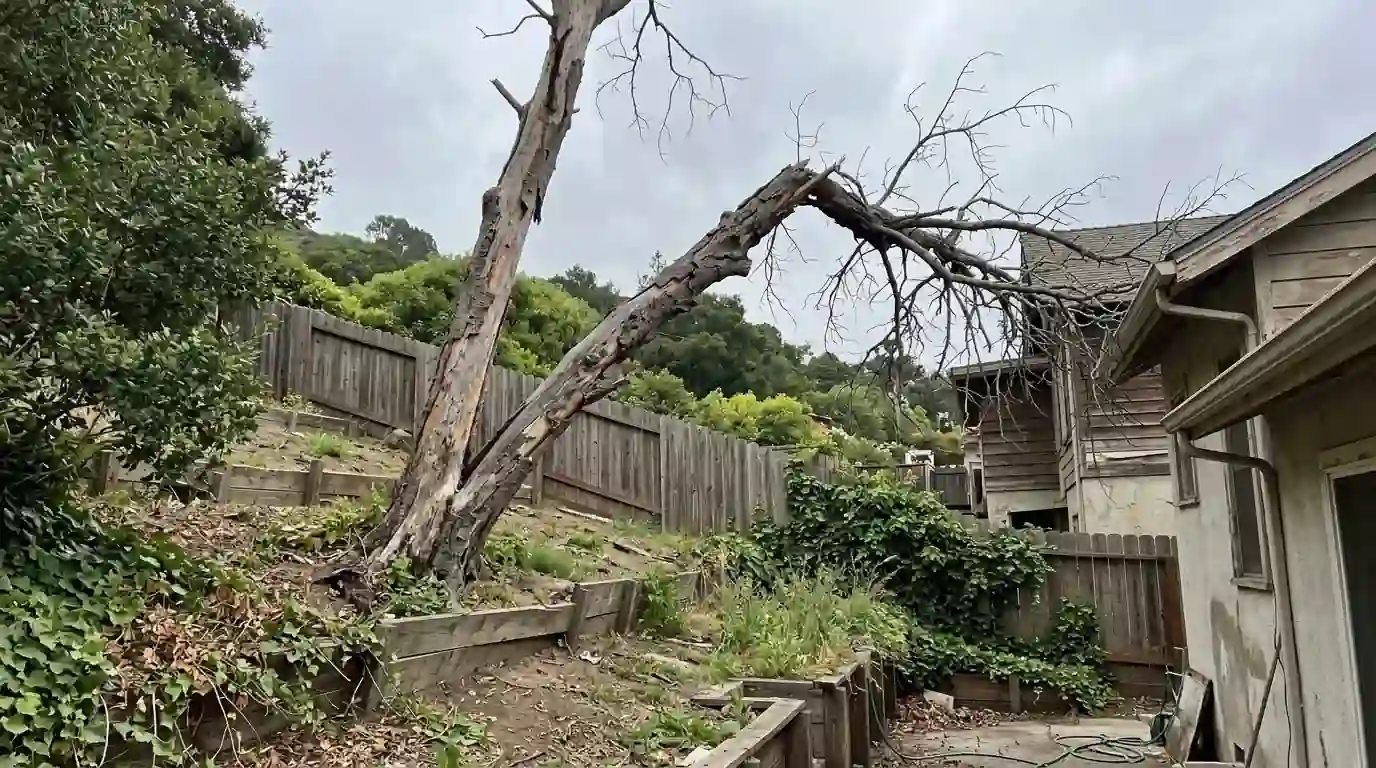
- Dead or decayed trunksWhen the wood can't be trusted to hold a climber, the crane takes the weight while each section is cut.
- Backyards with no side accessA crane can lift wood over the house to the street, so nothing has to be carried through the home's side yard.
- Large trees over pools, decks or gardensLifting sections out avoids dropping heavy wood onto features that are hard to repair.
What changes the cost of a crane removal?
Every job is priced after we see the tree. These are the things that move the number.
- Crane size and reachA tree far from the street needs a larger crane to carry the same weight, which changes the setup.
- Street use and traffic controlBlocking a lane on a busy or narrow road can call for approval, signage and a flagger.
- Weight and condition of the woodHeavy green eucalyptus and decayed trees both need more, smaller picks.
- Time on siteCrane work is planned in blocks of hours, so trees that come apart quickly cost less time.
- Wood disposalBig trunk rounds take more truck space and handling than brush.
- Wires near the boomThe service drop may need a temporary disconnect, and work near primary lines is something we don't do.
How a crane day runs, from street setup to final pick
We scout the crane position and the reach
We measure the distance from the street or driveway to the tree and check the ground for the outrigger pads. That reach decides the crane size and how large each piece can be.
We handle street use and neighbors
If the crane will block part of the road, we arrange the city's street use approval where needed and give neighbors notice of the date and times.
Our climber rigs each section to the hook
The climber chokes a sling around a section, the operator takes up the load, and only then does the cut happen.
The operator lifts the piece to the landing zone
Each section swings over the house to a cleared spot near the chipper and log truck, guided by a signal person on the ground.
The trunk comes down in big rounds
Once the canopy is gone, the trunk is taken in long sections or felled where there's room. The stump is then cut low for grinding.
We clear the street and the yard
Chips and rounds are loaded, the road is swept, and the outrigger spots are checked for any marks.
Oakland streets, slopes and wires that shape crane work
Hill streets above Highway 13 are the hard part. Roads near Upper Rockridge, Montclair and Shepherd Canyon are often narrow, curved and parked on both sides, and homes sit well above or below the pavement. We pick crane days carefully, sometimes early on a weekday, and ask neighbors to move cars ahead of time. A crane on soft winter soil also needs solid pads, so dry season scheduling helps on lots with no pavement for the outriggers.
Overhead wires shape every pick. PG&E keeps the primary lines on the pole clear, but we never swing a boom or a load near them. The service drop to the house can usually be disconnected by PG&E for the day. In the flats, older neighborhoods like Grand Lake and Crocker Highland bring big backyard trees boxed in by garages and fences, and that's where lifting wood over the roof to the street pays off most.
When does a crane beat climbing and lowering?
We weigh a few questions. Is the tree sound enough to hold a climber and rigging? Is there open ground to land pieces, or would every section have to be lowered between a house and a fence? How far is the yard from the street? If the tree is dead or cracked, if the canopy sits over a roof on all sides, or if the yard below is a garden you want left alone, the crane usually wins.
It doesn't always. A tree deep behind a house on a steep downhill lot may sit beyond the crane's reach, and some narrow hill roads can't fit the outriggers. In those cases we fall back on climbing with careful rigging, sometimes with a hazard-tree approach using a second anchor tree. We'll tell you which method fits your lot after we've walked it.
Work that often goes with crane-assisted tree removal
Where we handle crane-assisted tree removal
From the office on Martin Luther King Jr Way in Temescal and the Walnut Creek office on Bonanza Street, we cover Oakland and the East Bay. The biggest communities we serve, with a main ZIP code for each:
Crane-assisted tree removal questions we hear in Oakland
Does a crane damage the street or my driveway?
Rarely, because the outriggers sit on wide pads that spread the load. We check the surface first and avoid weak spots like old concrete over a hollow or soft soil after rain. If the only crane spot is a fragile driveway, we'll discuss setting up on the street instead.
Can a crane reach a tree in the backyard behind my house?
Often, yes. The crane sits on the street or driveway and swings its boom over the roof to the tree. What limits it is distance, since capacity drops as the boom extends. We measure the reach on our first visit and size the crane and pieces to match.
Do I need permission to park a crane on an Oakland street?
Blocking part of a public street can require city approval, and we handle that when the setup calls for it. We also give neighbors notice, since cars may need to move for the day. On some narrow hill roads, timing the work around traffic matters as much as the paperwork.
Is crane removal only for really huge trees?
No. Size is one reason, but condition and access matter just as much. A medium tree that is dead, cracked or surrounded by roof and fences can be a better crane job than a big, healthy tree standing in open lawn.
Saws, chippers, grinders and climbing gear from names like Stihl, Husqvarna and Vermeer
StihlHusqvarnaVermeerBanditMorbarkRaycoAltecPetzlSilkySherrillTeufelbergerNotchEchoToro
Need crane-assisted tree removal in Oakland or the East Bay?
Call and tell us what the tree is doing. Someone picks up any hour, and we can usually talk you through the next step on that first call.