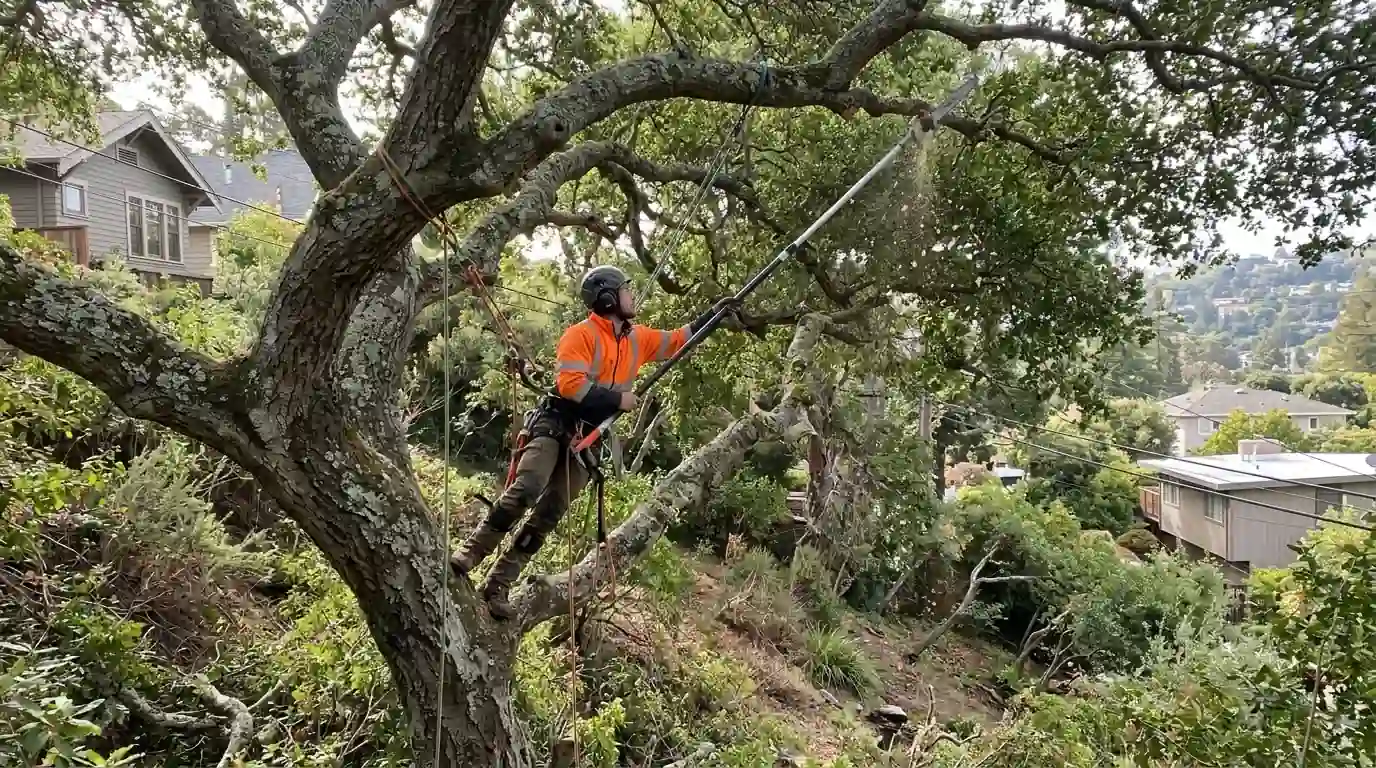
Tree cabling and bracing in Oakland, CA
A big tree with two equal trunks rising from one fork can split under the weight of a wet Oakland winter. Cabling and bracing tie those stems together so a weak union doesn't fail onto your house.
Quick answer
Tree cabling and bracing adds steel support to a weak structure. A cable runs high between two leaders to limit how far they spread in wind, and a threaded rod through the trunk holds a cracked or weak union together. You need it when a valuable tree has codominant stems, included bark or a fresh crack. We install it, prune to lighten the load and inspect it over time.
What tree cabling and bracing involves in Oakland
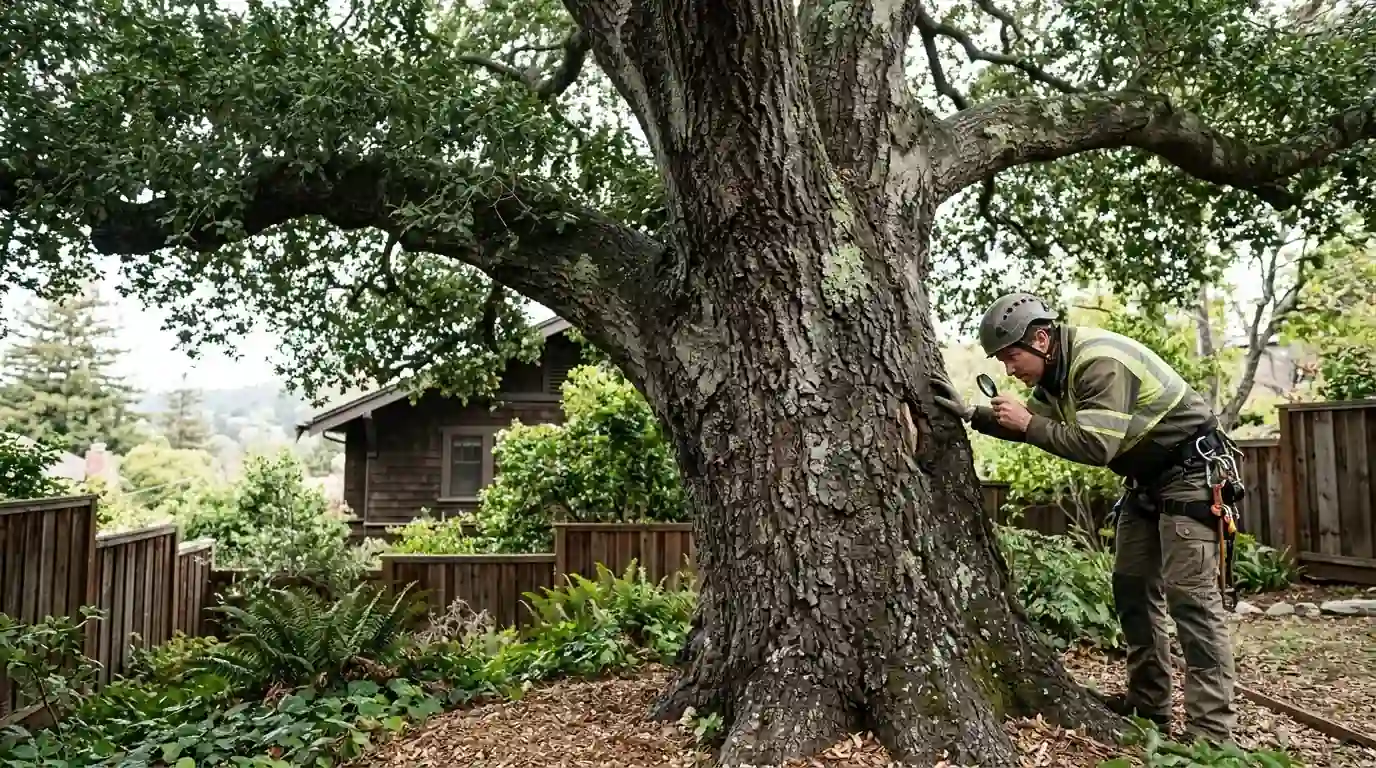
The weak spot we see most often is a codominant fork, where two trunks of about the same size grow up side by side. As they thicken, they press bark between them instead of forming a strong collar of wood. That pinched bark, called included bark, works like a wedge. Stand under the fork and you'll see a tight V with a seam running down it, sometimes weeping sap or already showing a crack.
Coast live oaks, liquidambar, Chinese elm and old fruit trees in Oakland yards grow these forks all the time, and so do big London planes along older streets. Many of them stand next to houses, garages or driveways. Taking the tree down is one choice. For a healthy tree that shades the house and anchors the yard, a well placed cable and rod can carry it safely for many more years.
Hardware alone is not the whole answer. A cable reduces movement, but if the canopy stays heavy and long on one side, the stress on the union keeps building. So nearly every cabling job here also includes shortening the heaviest limbs to cut end weight. And when a split already runs deep into the trunk, or the base has decay, we'll say plainly that support won't make the tree safe.
Does your tree have a fork that could split?
- Two trunks of equal sizeCodominant stems rising from one point share the load evenly, which turns the union into a stress point in wind.
- A tight V-shaped unionA narrow fork with bark pinched inside it is weaker than a wide U-shaped union with a raised ridge of bark.
- A seam or crack below the forkA dark line or open crack running down from the union means the stems are already pulling apart.
- Sap or wet staining at the crotchOoze or a damp streak from a fork can mean the bark is tearing inside as the stems move.
- Heavy limbs over a roof or drivewayA long horizontal limb reaching over a structure may need a cable to share its weight with the rest of the tree.
- A past stem failureIf one stem of a multi-trunk tree has already broken off, the remaining stems often carry the same weakness.
How we install support that holds for years
Inspect the union and the whole tree
We look at the fork from the ground and from a climb, sound the trunk for decay and check the root flare. A tree with rot at the base or heavy root loss is not a candidate.
Lighten the load first
Before any hardware goes in, our climber reduces the longest, heaviest limbs on the stems being supported. Less sail area means less force on both the union and the cable.
Set the cable high in the canopy
A steel cable usually goes about two thirds of the way from the union up toward the tops of the stems. We anchor it with eye bolts drilled through sound wood and leave a little slack so the tree can still sway and build strength.
Add a through-rod where needed
For a cracked or badly included union, we drill straight through the stems and install a threaded steel rod with washers and nuts. The rod clamps the union and keeps the crack from opening further.
Check alignment and fit
Each cable runs in a straight line between anchors, and we confirm the hardware sits flush against the wood. Misaligned hardware wears faster and can tear bark.
Book the inspections
We note the date and the hardware used, then come back to look at it. Cables can loosen or fray, and anchors can be overgrown or develop decay, so periodic checks are part of the job.
Why Oakland's winters test weak tree forks
Our trees spend half the year dry and then take on heavy rain and wind from winter storms. The atmospheric rivers of late December 2022 into January 2023 dropped trees across the East Bay, and many of the failures we cleaned up were split forks and broken leaders rather than whole trees tipping over. Wet leaves add weight, gusts work the union back and forth, and soaked soil gives the roots less grip.
Cabling also fits Oakland's tree rules. A coast live oak is protected from 4 inches in diameter and most other trees from 9 inches, so removing a large split-prone tree usually means a permit and replacement planting. Supporting a sound tree keeps it standing without that process. In Trestle Glen and Oakmore, where big oaks lean over homes on steep lots, cabling is often the practical way to keep a valued tree.
What affects the cost of cabling and bracing?
Every job is priced after we see the tree. These are the things that move the number.
- Height of the anchorsCables set high in a tall tree mean a longer climb and more rigging time.
- Number of cables and rodsA single fork needs one cable, while a tree with three or four leaders may need several in a pattern.
- Pruning done at the same visitReducing heavy limbs while the climber is up adds climbing and cleanup time.
- Hardware typeThrough-rods take more drilling and fitting than a simple cable between two eye bolts.
- Obstacles around the treeTrees close to roofs, fences, service drops or steep slopes take extra care to work in safely.
- Inspection scheduleHardware checks over the following years belong in the overall plan for the tree.
Work that often goes with tree cabling and bracing
Where we handle tree cabling and bracing
From the office on Martin Luther King Jr Way in Temescal and the Walnut Creek office on Bonanza Street, we cover Oakland and the East Bay. The biggest communities we serve, with a main ZIP code for each:
Tree cabling and bracing questions we hear in Oakland
How long does a tree cable last?
Steel cable and hardware can serve for many years, but the system is never install and forget. The tree keeps growing, anchors can be swallowed by new wood, and cables can loosen or rub. We recommend an inspection every year or two and after major storms, and we replace worn parts as needed.
Will drilling for a cable damage my tree?
A properly installed system does very little harm. Anchors go through sound wood, and the tree seals around the small drill holes over time. Real damage comes from wrapping cable or wire around limbs, which girdles the bark, or from hardware that's never checked. We never wrap a limb.
Why does a narrow fork with trapped bark need a cable?
Included bark is bark trapped inside a narrow fork as two stems grow against each other. It keeps wood from joining across the union, so the stems are held together by little more than pressure. Under wind or wet weight, those forks split far more easily than a fork with a solid collar.
When is cabling not enough to save a tree?
When decay has hollowed the union or the base, when a crack runs deep into the main trunk, or when the roots are failing. Hardware can't hold wood that has lost its strength. In those cases we explain the risk honestly and plan a removal instead of installing support.
Can you brace a tree that has already started to split?
Often, if the crack is recent, the wood around it is sound and the stems haven't separated far. We'd pair a through-rod at the crack with a cable higher up and reduce the load on both stems. If the split is wide or the wood is decayed, bracing won't make it safe.
Saws, chippers, grinders and climbing gear from names like Stihl, Husqvarna and Vermeer
StihlHusqvarnaVermeerBanditMorbarkRaycoAltecPetzlSilkySherrillTeufelbergerNotchEchoToro
Need tree cabling and bracing in Oakland or the East Bay?
Call and tell us what the tree is doing. Someone picks up any hour, and we can usually talk you through the next step on that first call.