Brush and Lot Clearing
Upper Millsmont slopes fill with broom, dry grass and young eucalyptus, and clearing them is often the first step toward fire compliance.
DetailsMillsmont climbs from MacArthur Boulevard near Mills College up into the hills, so one neighborhood holds both level bungalow blocks and steep lots near wildland brush. We remove trees and clear brush across both halves.
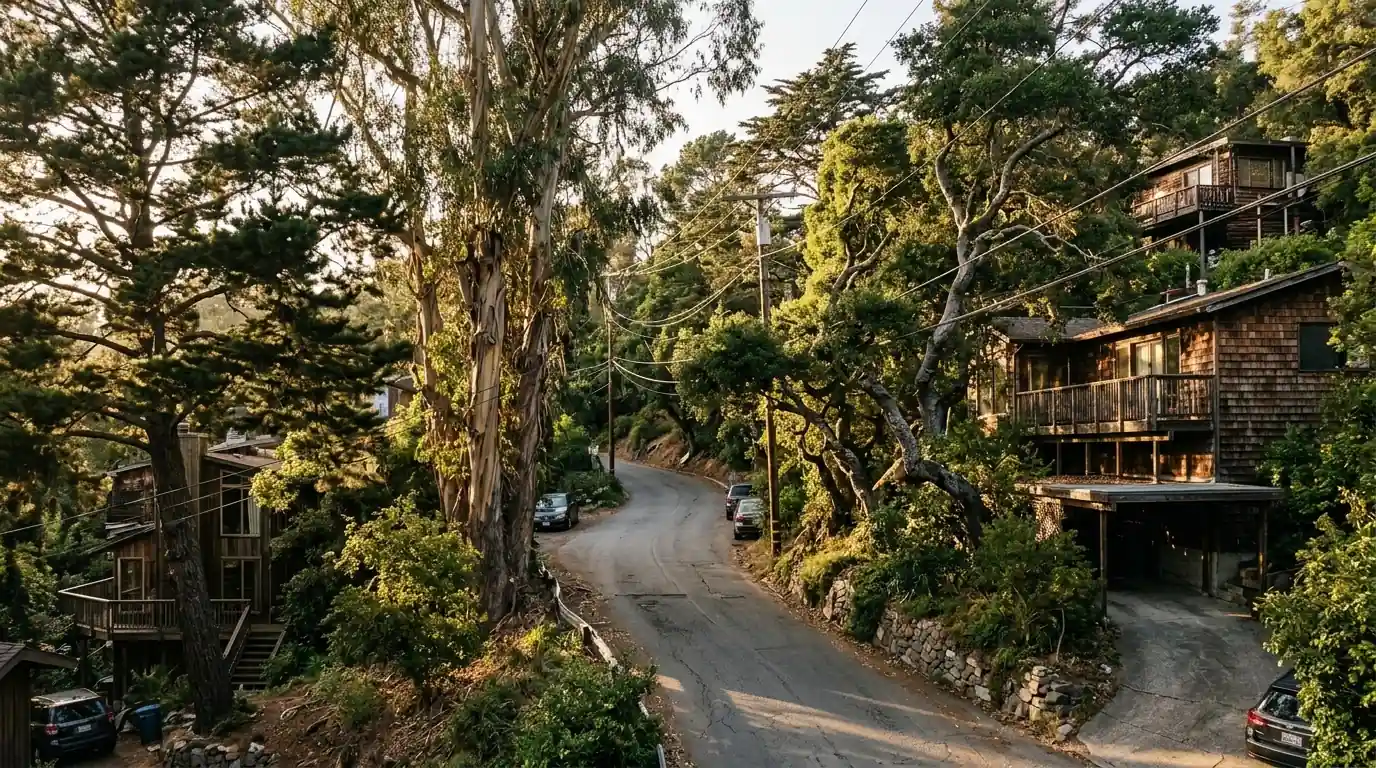
We remove trees and clear brush in Millsmont, where the lower streets near Mills College stay flat and the upper streets rise into the hills. Down low, jobs look like typical yard tree removals and trimming. Up the hill, they shift to brush clearing, fire spacing, and taking down eucalyptus and pine, with Oakland's wildfire inspection rules applying on many upper lots.
The lower part of Millsmont, next door to Maxwell Park and closest to MacArthur Boulevard and the Mills College campus, has older homes on modest lots with mature yard trees: oaks, liquidambar, fruit trees and a scattering of pines. Farther uphill, streets bend and steepen, and houses sit on terraced lots with views across the flatlands.
Up the hill, the plant mix changes. Eucalyptus, Monterey pine, acacia and French broom grow thick along the steeper slopes and lot edges, along with juniper hedges planted decades ago. Dry grass on unbuilt slopes turns brown by early summer. That fuel load is why many upper lots get yearly fire inspections.
Lots on the upper streets often include an uncleared back slope that the owner rarely visits. Brush and young eucalyptus fill in fast there, and dead branches pile up underneath. Clearing it every year or two keeps it manageable and much less expensive than starting over with a wall of growth.
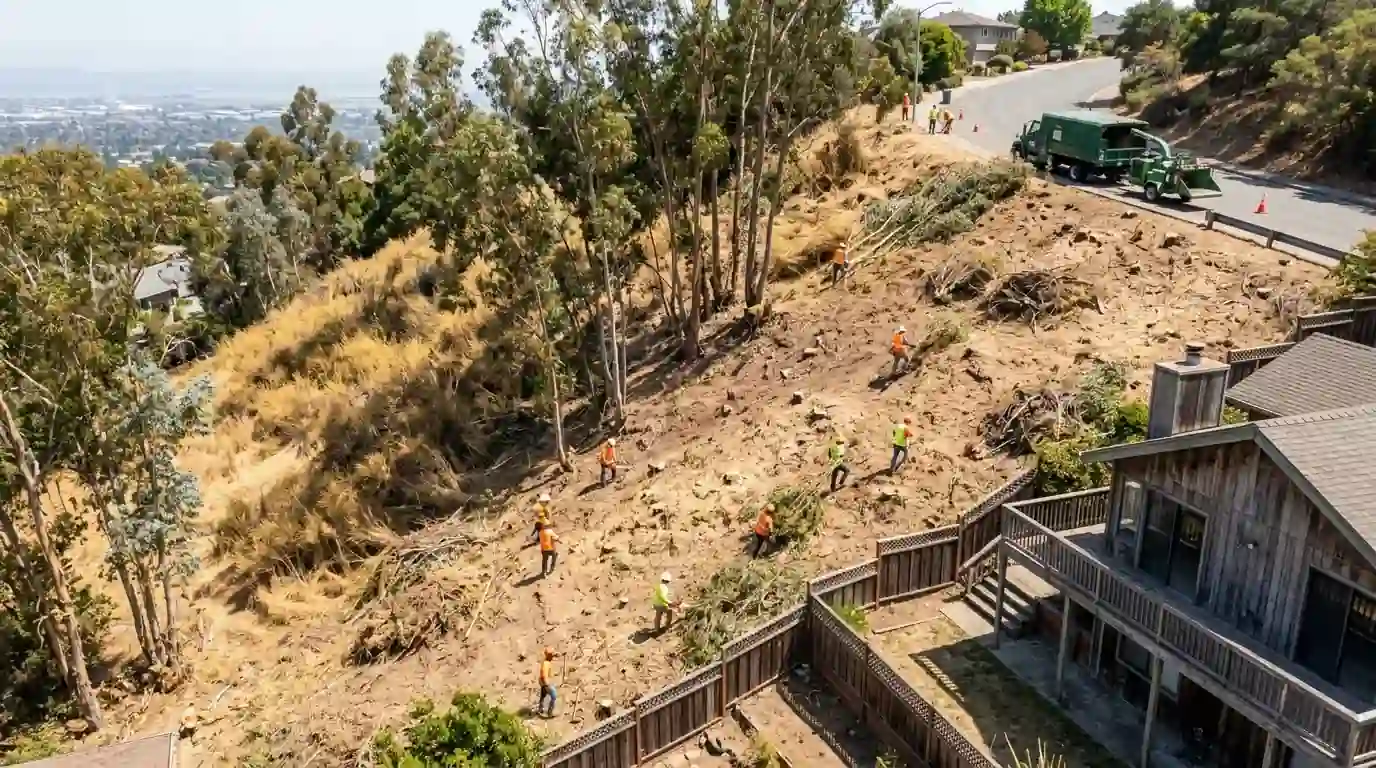
Upper Millsmont slopes fill with broom, dry grass and young eucalyptus, and clearing them is often the first step toward fire compliance.
DetailsBlue gums on hill lots shed bark and branches and can drop big limbs, so many owners choose to take them out.
DetailsOld junipers beside houses are dense, resinous fuel, and pulling them out clears the space right around the home.
DetailsDown near Mills College, oversized yard trees crowding houses and lines are the main removal calls.
DetailsLifting limbs, spacing shrubs and clearing needles helps upper lots meet the Zone 1 and Zone 2 rules.
DetailsOn upper Millsmont lots inside Oakland's wildfire district, Zone 2 runs from 30 to 100 feet off the house, or to the property line if that's closer. There, trees and shrubs need horizontal and vertical spacing, dead plants and leaf litter must be cleared, and grass kept at 4 inches or less. Closer in, Zone 1 calls for limbs 6 feet off the ground and 10 feet from the roof.
Protected-tree rules apply everywhere in the neighborhood. Eucalyptus isn't covered by Oakland's protected-tree chapter, which is why many hill owners remove it without a permit. A coast live oak of 4 inches or a non-oak of 9 inches needs a permit first. We check species and size on every tree before quoting fire clearing or removal.
On the flatter streets, the chipper parks at the curb and the work runs like any yard job. Upper streets are narrower and winding, with fewer places to park a truck, so we pick the chipper spot carefully and keep a lane open for neighbors and emergency vehicles.
Back slopes on upper lots are often too steep for wheelbarrows. Brush gets bundled and dragged uphill by rope, or we chip it on a flat landing and spread or haul the chips. During the dry season we keep saws and chippers away from dry grass, since a spark from a saw can start a fire on a hot afternoon.
ZIP codes for Millsmont: 94619.
Not under Oakland's protected-tree chapter, which leaves eucalyptus out. That makes eucalyptus removal simpler than oak or redwood work. We still plan the takedown carefully, because big blue gums are heavy and drop bark and limbs. If any protected trees are nearby, we make sure they aren't damaged.
Enough to meet the fire rules for your distance from the house. Within 30 feet, limbs come up and plants get spaced. From 30 to 100 feet, dead material goes, grass stays at 4 inches, and shrubs and trees need gaps between them. We walk the slope with you and mark what stays.
Yes. Junipers next to a house are dense and burn hot, so many hill owners take them out. We cut them down, grind or dig out the stumps, and haul everything. Clearing that first five feet around the house fits the direction of the proposed Zone 0 rules.
Late spring is usually best, once grass has dried enough to cut cleanly and before the hottest stretch of summer. That timing gets fuel down ahead of fire season and before the yearly inspection. Fall touchups pick up regrowth and fallen needles. We avoid running saws over dry grass on hot, windy afternoons.
Call any hour. Tell us the street, the tree and what changed, and we will plan the visit around your access.