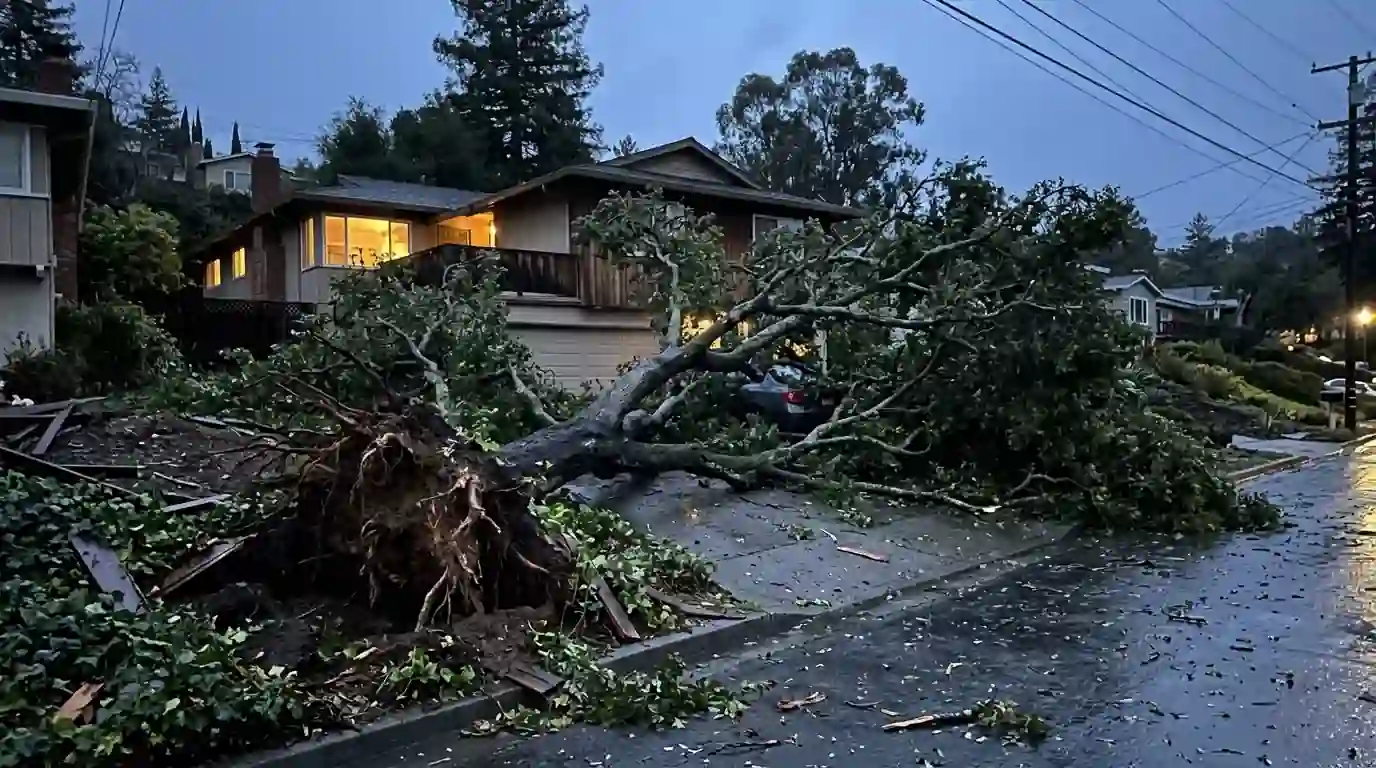
Storm damage tree cleanup in Oakland, CA
After a winter storm in Oakland, the yard can be a tangle of broken limbs, split trunks and branches still hung up overhead. We sort what's dangerous from what can wait, then clear it piece by piece.
Quick answer
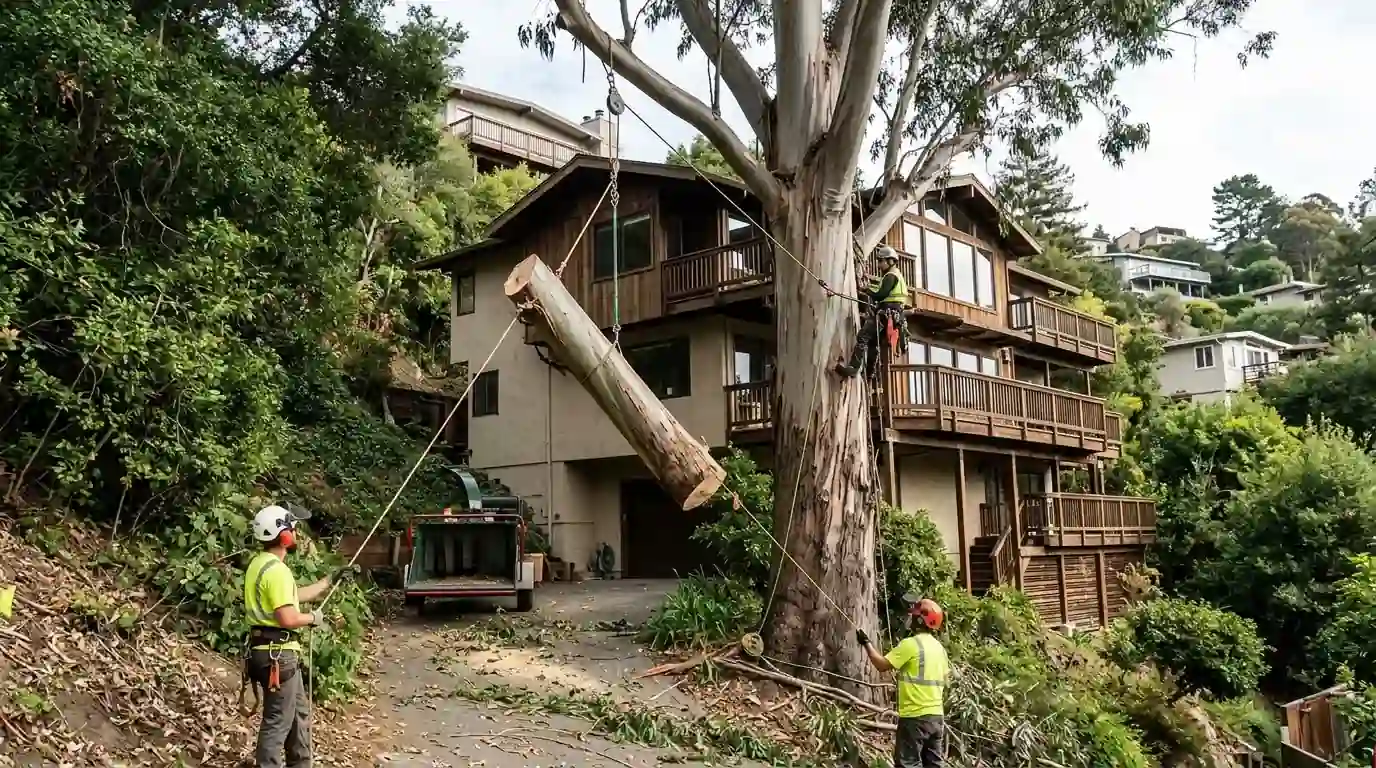
Storm damage cleanup is the removal of broken limbs, hanging branches and downed trees after wind or heavy rain. You need it when wood is on a roof, car, fence or driveway, or when broken limbs are still caught in the canopy. We triage the site, take down hangers first, cut and remove what's on the ground, and leave the standing tree in safer shape.
What storm damage cleanup involves in Oakland
Most of the East Bay's tree damage arrives in a handful of nights each winter. Atmospheric-river storms soak the ground for days, and then the wind picks up. Saturated soil lets whole root plates tip, while heavy canopies of eucalyptus, pine and oak catch every gust. The storms of late December 2022 into January 2023 dropped trees all over Oakland, from the flats around Lake Merritt to the ridges along Skyline Boulevard. Our phones are busiest between November and March, often after dark.
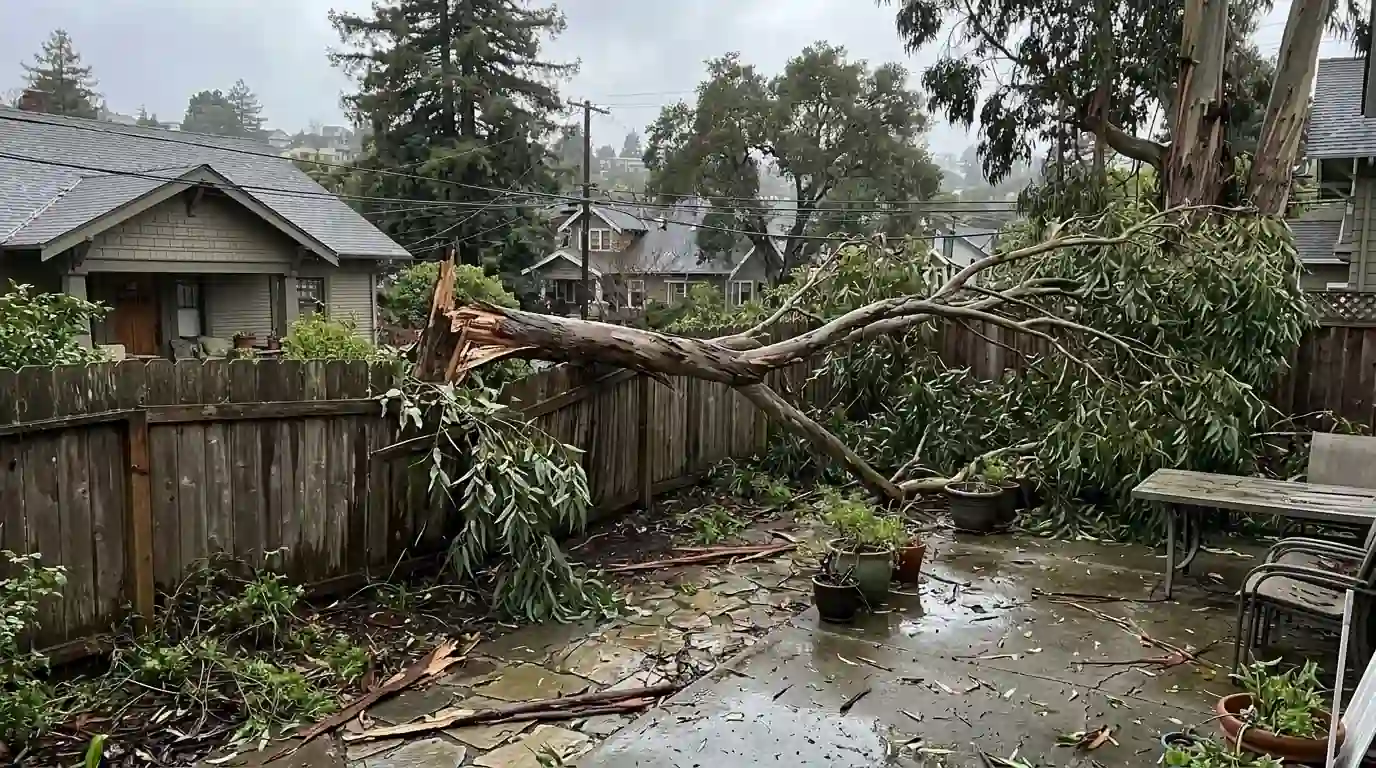
The first job after a storm isn't cutting. It's sorting. A limb lying on the lawn is a mess, not an emergency. A branch hanging by a strip of bark over the back door is a hazard right now, and so is a trunk resting on a roof, a tree pressing on the service drop, or a split leader that could finish tearing in the next gust. We walk the property, look up as much as down, and rank the work before a saw starts.
Hangers are the part people underestimate. Arborists call them widowmakers for a reason: a broken branch caught in the crown looks settled until wind or vibration shakes it loose. Our climber removes those first, from above or from a lift, before anyone works on the ground beneath them. Once the overhead is clear, the downed wood gets cut and hauled. If the storm left the tree itself unstable, emergency removal may be safer than cleanup alone.
How do we work through a storm-damaged yard?
Walk the site and rank the hazards
We start with what's overhead, then what's under load, then what's simply lying on the ground. Anything touching wires waits for PG&E.
Clear hangers first
Our climber or lift operator takes out broken limbs caught in the crown, lowering them on rope so nothing drops into the work zone.
Release tension in a planned order
Trees pinned against roofs or other trees store energy like a bent spring. We make relief cuts in sequence so the wood moves away from people and structures.
Take weight off the roof
Limbs on a house come off in small sections, lowered rather than rolled, so we don't add damage. We point out openings so a roofer can tarp them.
Recut the torn stubs
Ragged branch ends left on the standing tree get cut back to a clean point near a lateral or the trunk, which helps the tree close the wound.
Chip and haul
Brush runs through the chipper, wood is cut and loaded, and the yard is raked. Rounds you'd like to keep get stacked out of the way.
Which storm damage needs a call right away?
- A tree or limb on the houseWeight on a roof can shift as wood dries or wind returns, and rain gets in through any punctures.
- Branches caught overheadBroken limbs hung in the canopy can fall without warning, so keep people and pets out from under them.
- Lines touched or pulled downIf a tree is on a power line, stay well away and call PG&E. A limb resting on the service drop to your house also needs PG&E before we work near it.
- A lifted root plateCracked soil or a raised mound on one side of the trunk means the roots have let go and the tree may keep tipping.
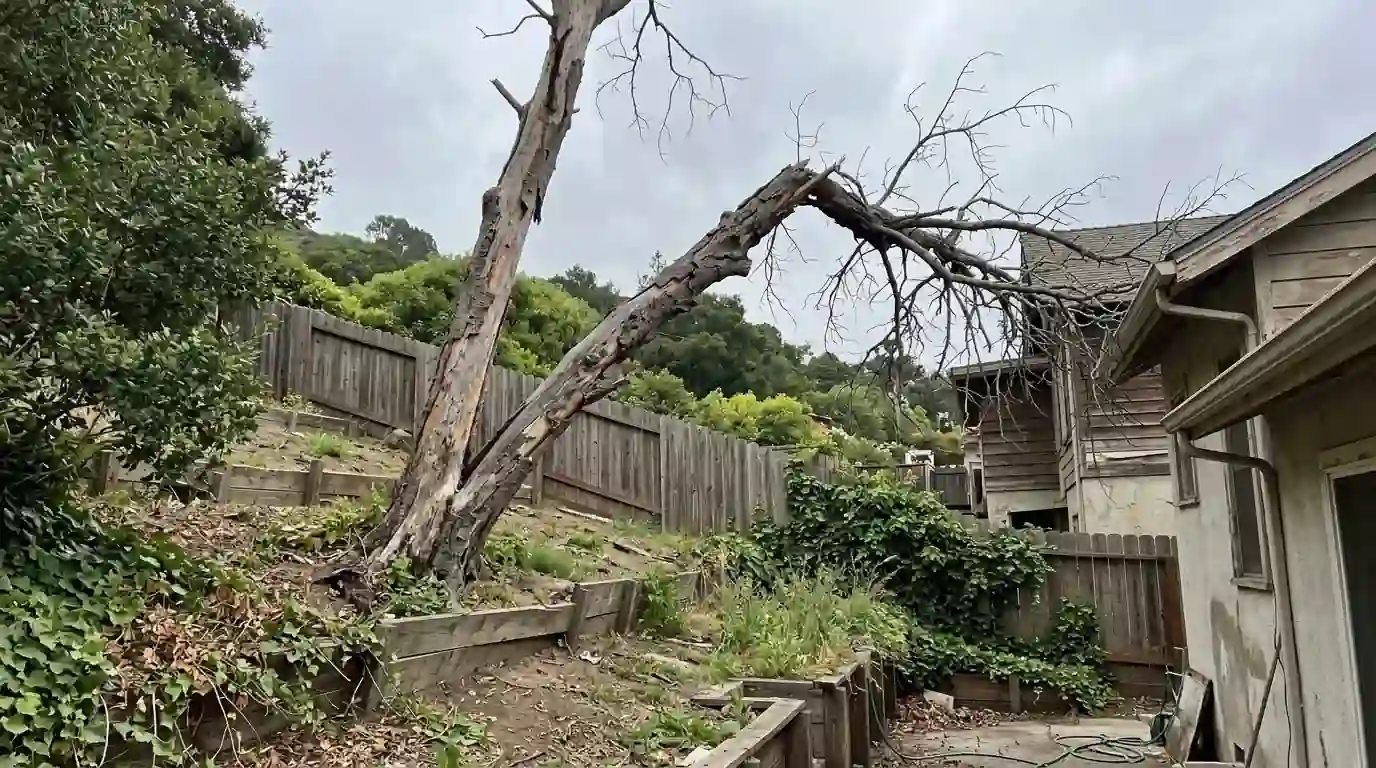
- A fresh split in the trunkA vertical crack where two stems meet can open further under load and bring half the tree down.
- Debris blocking a road or drivewayNarrow hill roads become impassable fast, and fire engines need that access too.
What does a storm mean for Oakland's tree rules?
If a protected tree in Oakland, such as a coast live oak 4 inches DBH or larger, becomes an immediate threat to safety or property after a storm, the city can waive the removal permit. The removal still has to be reported to the city on the first business day after. Cleaning broken limbs off a standing oak is a different job from taking the oak down, and we'll tell you which side of that line your situation sits on. Our permit help covers the follow-up report as well.
Street trees work differently. The City of Oakland handles its street trees in hazardous or emergency situations, so a city tree across the sidewalk is a call to the city first. On private property, photos matter. Before we touch anything, take wide shots of the tree, the damage and the house, plus close-ups of the break. Many owners send these to their insurance company. We don't predict what any policy will pay, but we describe the work in writing so you have a clear record. In Berkeley and Walnut Creek, the same photo habit helps, and each city has its own process for storm removals.
What shapes the size of a storm cleanup?
Every job is priced after we see the tree. These are the things that move the number.
- Weight on a structureLifting a limb off a roof takes rigging and patience, while ground debris goes much faster.
- Number of hangersEvery branch caught overhead means a climb or a lift and a careful lower.
- Tension and bindsWood twisted under load takes more cuts and more planning to release safely.
- Conditions after the stormMud, blocked streets and slick hillside yards slow the haul-out.
- Volume of debrisA few limbs fit in one chipper load, but a whole fallen eucalyptus is a different job.
- Follow-up workSome trees need pruning or removal after the cleanup, and that's a separate decision we talk through with you.
Work that often goes with storm damage cleanup
Where we handle storm damage cleanup
From the office on Martin Luther King Jr Way in Temescal and the Walnut Creek office on Bonanza Street, we cover Oakland and the East Bay. The biggest communities we serve, with a main ZIP code for each:
Storm damage cleanup questions we hear in Oakland
What should I photograph before storm cleanup starts?
Take wide shots showing the whole tree, where it landed and what it hit, then close-ups of the break, any roof or fence damage and the root area. Include something for scale. Do it before we cut, because once the wood moves the record is gone. Stay out from under hanging limbs while you shoot.
Can you clean up storm damage while it's still raining?
Ground cleanup of downed limbs can often go ahead in rain, as long as nothing is near wires. Climbing in high wind or lightning is off the table, so hangers may have to wait for the gusts to drop. In the meantime we make the site safer, for example by roping off the area under the hangers.
Who handles a neighbor's tree that fell into my yard?
Start by talking with your neighbor. Under California law, a tree whose trunk stands partly on both lots belongs to both owners. Either party can call us to clear the debris, and many people sort out who covers it afterward through their insurance companies. We work for whoever arranges the job and keep the record of what we did.
Does a tree that lost one big limb need to come down?
Not always. If the trunk is sound and the root plate didn't shift, a clean recut of the broken limb may be enough. A tree that lost a third of its crown, has a split trunk or tipped at the roots is a stronger candidate for removal. We look at it once the cleanup is done and give you a straight read.
Saws, chippers, grinders and climbing gear from names like Stihl, Husqvarna and Vermeer
StihlHusqvarnaVermeerBanditMorbarkRaycoAltecPetzlSilkySherrillTeufelbergerNotchEchoToro
Need storm damage cleanup in Oakland or the East Bay?
Call and tell us what the tree is doing. Someone picks up any hour, and we can usually talk you through the next step on that first call.